Faced with shrinking production budgets, Boîte à Outils Broadcast (BOB), the technical service provider for Clique, produced by Première Fois Productions for Canal+, redesigned its entire workflow around NetOn.Live’s LiveOS. The result: a full year of remote production without a single technical interruption, a streamlined workflow, and a centralized infrastructure that can be shared across multiple productions.
To deliver Clique for Première Fois Productions, BOB, led by Cyril Mazouer, relied on a multi ME production switcher and dedicated playout systems. Each function—video switching, playout, graphics, and recording—required its own tool and dedicated operators.
This setup fully met the show’s production requirements. However, with budgets under pressure, Première Fois Productions needed a more cost-effective solution, and BOB had to deliver one without compromising quality or reliability.
Rather than simply replacing individual pieces of equipment, BOB decided to rethink its entire architecture around LiveOS, NetOn.Live’s ST 2110-based, software-defined live production platform, which brings all these functions together in a single environment.
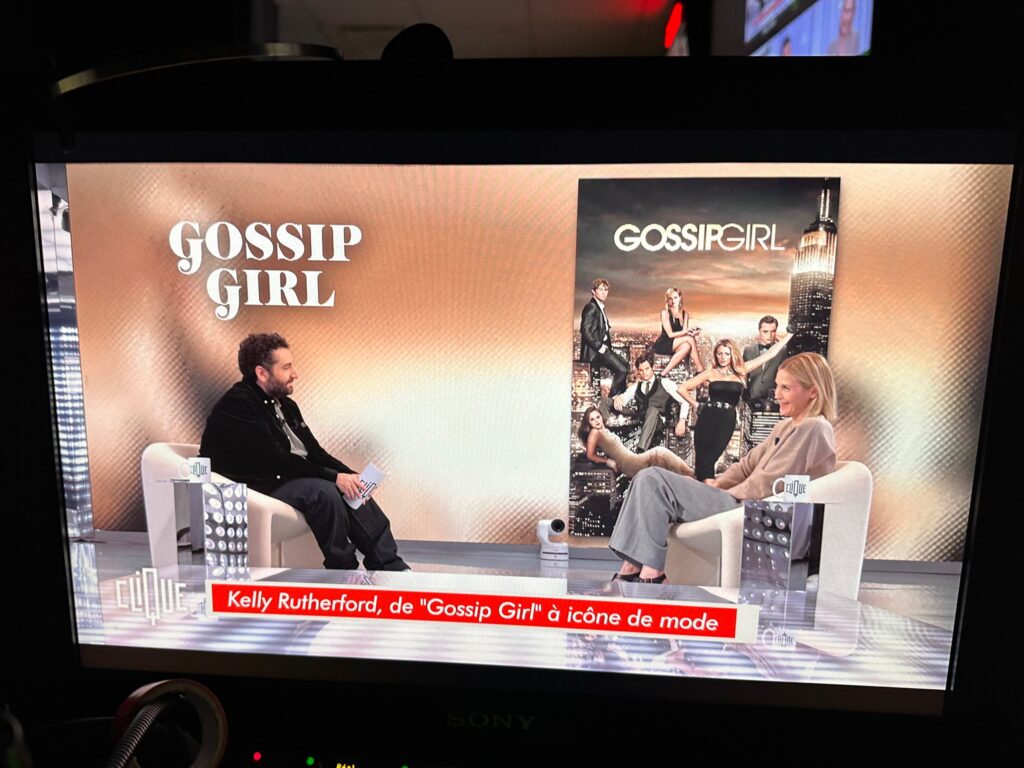
The Clique studio, located on Rue Cler in Paris, was connected to BOB’s central infrastructure in Bondy via a dedicated 25 Gbps dark fiber connection.
Signals from six cameras and other video sources were transported to Bondy using ST 2110. There, LiveOS handled the main production functions: video switching, playout, graphics, and backup recording.
The setup included two software-based production switchers, five media players, and integrated tools for countdown timers and managing content displayed on the studio’s LED screen.
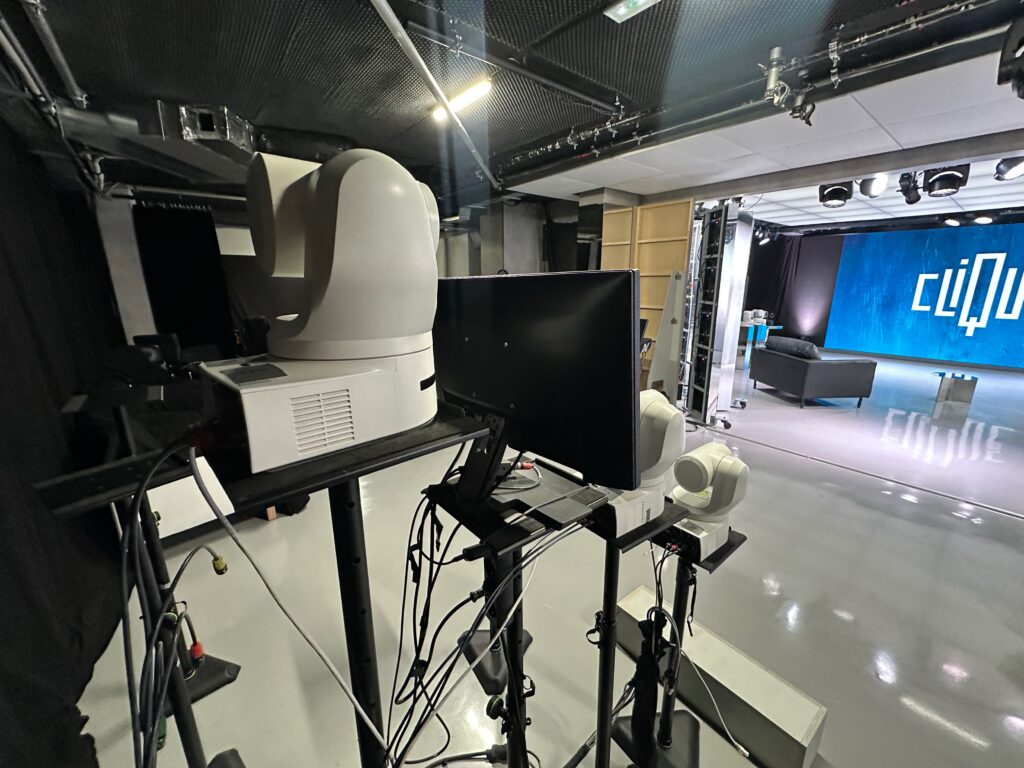
To preserve the production team’s familiar working environment, the multiviewers they already used remained at the studio. Keeping this infrastructure on-site also made it possible to switch to a backup SDI production switcher if needed.
Most of the processing therefore took place in Bondy, while the studio control room retained its monitoring tools and backup capabilities.
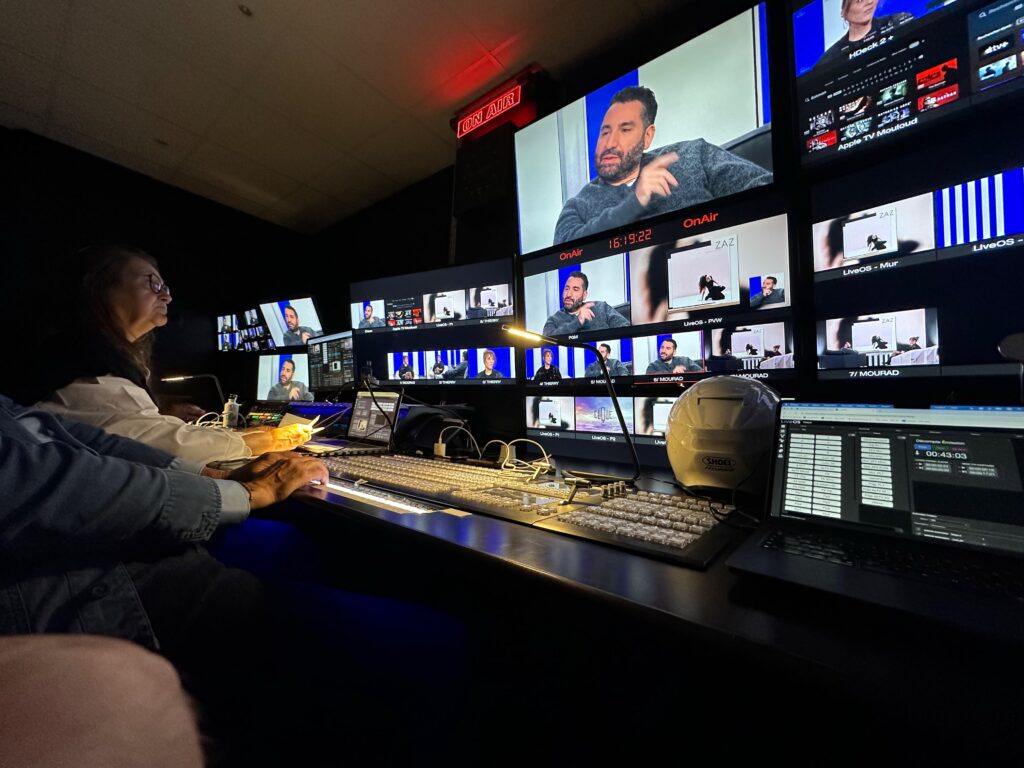
LiveOS macros allowed multiple operations across different modules to be triggered with a single action. This automated a significant proportion of repetitive technical tasks.
Only three team members interacted directly with LiveOS:
The director, for video switching;
The editorial producer, for playout;
The script supervisor, for countdown timers and selecting content displayed on the LED screen.
All three workstations shared the same set of macros.
Automation even extended to lighting, thanks to integration with the grandMA lighting console.
None of these users were LiveOS specialists. Just a few hours of initial training, followed by support during the first recording sessions, were enough for them to operate the platform independently, thanks to its intuitive interface and straightforward workflows. The rest of the team could focus on the show’s content.
For an entire year, Clique was produced remotely using LiveOS without a single technical interruption, across more than 100 episodes.
The operational demands were significant. On some days, up to five episodes were recorded, with nearly 200 media assets prepared and organized into playlists the day before.
The backup SDI production switcher kept at the studio was not used once throughout the entire year.
From playout and video switching to graphics, countdown timers, and recording, the entire workflow was managed within a single platform.
This experience demonstrates that remote, software-based production is no longer limited to experimental projects. It is a proven alternative for recurring television productions.
Beyond simplifying the workflow, LiveOS changes the way a technical service provider like BOB can operate its infrastructure. The economic benefit does not come from the acquisition cost of the technology itself, but from how resources are utilized.
Traditional broadcast infrastructure is often tied up serving a single production. With LiveOS, production functions are centralized and virtualized. As soon as a Clique production session ended, the resources became available for other uses.
The same infrastructure can therefore support multiple projects, increasing both utilization and return on investment.
“With LiveOS, we haven’t just made the production of Clique more efficient; we’ve changed the way we operate our infrastructure. Instead of dedicating expensive equipment to a single show, we can share it across multiple clients and maximize the return on every investment.”
— Cyril Mazouer, Boîte à Outils Broadcast (BOB)
For Clique, the transition to LiveOS goes far beyond simply replacing equipment. It brings automation, ease of use, and centralized resource management together in a single platform.
For production companies, this means greater control over costs. For technical service providers, it means no longer having to dedicate an entire infrastructure to a single show. Instead, they can use the same resources across multiple clients, maximizing utilization and profitability.
For more info, contact BOB here.