SMPTE ST 2110 has become the foundation of modern IP-based live production, providing the deterministic, synchronized transport broadcasters rely on for mission-critical operations. Within facilities and managed production environments, ST 2110 delivers the reliability, interoperability, and low latency needed for live content creation. However, as production workflows increasingly extend into cloud and distributed compute environments, new challenges emerge. Technologies such as PTP timing and multicast networking, which underpin ST 2110 deployments, are not always practical or available in public cloud infrastructures.
LiveOS from NetOn.Live addresses this challenge by combining robust ST 2110 connectivity with support for software-native transport mechanisms such as MXL and Matrox Origin Fabric. While ST 2110 remains the preferred choice for real-time live production, MXL and Origin Fabric enable efficient media exchange between applications running on servers, clusters, and cloud infrastructure without requiring traditional broadcast timing architectures. This allows media services to scale dynamically while maintaining seamless connectivity with live production environments.
By supporting both synchronous and asynchronous media transport, LiveOS provides a bridge between traditional broadcast operations and cloud-native workflows. Broadcasters can continue to leverage the proven reliability of ST 2110 where it makes sense, while adopting modern software-based processing, and distributed production workflows using technologies better suited to cloud-scale deployments.
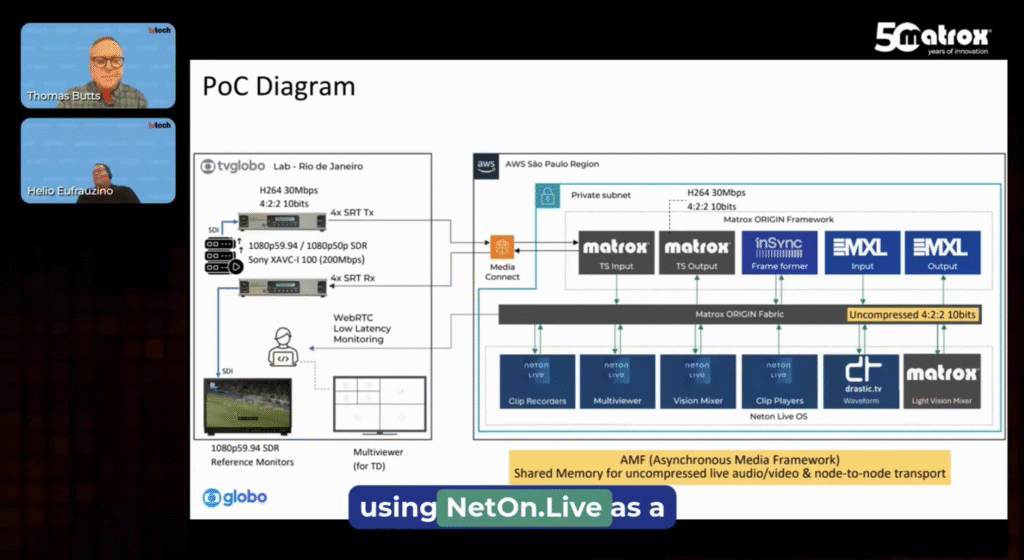
NetOn.Live is proud to support the MXL initiative and contribute to its development. Earlier this year, the company participated in the TV Globo multi-vendor MXL proof of concept, demonstrating how different vendors can successfully interoperate within an open MXL ecosystem. The project highlighted the potential for vendor-neutral software workflows and reinforced the industry’s growing commitment to open, flexible media architectures. You can rewatch the webinar explaining the PoC here.
The increasing momentum behind MXL reflects a broader industry shift toward software-defined production. As broadcasters look to combine the reliability of established broadcast standards with the flexibility of cloud-native technologies, approaches that unite ST 2110, MXL, and frameworks such as Matrox Origin will play an important role in enabling the next generation of scalable, interoperable media workflows.